Tips for Planting Trees in Iowa Soil

Table of Contents
Understand Your Soil Before You Plant
How to Amend Clay Soil for Trees
Select the Right Tree for Your Site and Hardiness Zone
Dig the Planting Hole Correctly
Handle the Root Ball and Set Planting Depth
Tree Watering Guide for New Plantings
Tree Planting Services West Des Moines and Beyond
Frequently Asked Questions
Last Updated: September 1, 2026
Understand Your Soil Before You Plant
Before you dig a single hole, you need to understand what you're working with. Tips for planting trees in Iowa soil start with soil assessment because Iowa's heavy clay composition fundamentally changes how trees establish themselves. Clay soil drains slowly, compacts easily, and creates conditions that can suffocate roots if you don't account for its properties from the start.
Most Iowa soils fall into one of two categories: clay-based or clay-loam mixtures. Both retain water longer than sandy soils found elsewhere, which sounds beneficial until a tree sits in waterlogged conditions for weeks after planting. The soil temperature in Iowa also fluctuates dramatically between seasons, affecting root development timing.
Start by doing a simple percolation test. Dig a hole about 12 inches deep in the area where you plan to plant. Fill it with water and observe how long it takes to drain. If water remains after 24 hours, you're dealing with poor drainage. This tells you immediately whether you need to amend the soil or select a tree species adapted to wet conditions.
Check your soil pH as well. Most Iowa soils lean slightly acidic to neutral (pH 6.0-7.5), which works for many species but matters when selecting trees (extension.iastate.edu). Some species thrive in acidic conditions while others prefer neutral or slightly alkaline soil. Knowing your baseline pH helps you choose trees suited to your specific site conditions.
Anderson Tree Care recommends getting a professional soil test done through your local extension office. It costs relatively little and provides specific nutrient data, texture breakdown, and recommendations tailored to your exact location. This one step prevents costly mistakes down the road.
How to Amend Clay Soil for Trees
Clay soil amendment is essential for establishing healthy trees in Iowa. You cannot simply plant a tree in unmodified clay and expect it to thrive. The goal is improving soil drainage and aeration while adding organic matter that feeds soil biology.
The most effective amendment strategy is incorporating organic matter into the planting area. Work 2-4 inches of compost or aged bark mulch into the top 12-18 inches of soil around your planting hole (extension.oregonstate.edu). This improves soil structure, increases pore space, and enhances drainage without dramatically changing the soil's fundamental character.
Never amend only the planting hole itself. This creates a "bathtub effect" where water pools around the root ball because amended soil drains faster than surrounding clay. Instead, amend a wider area, at least 3-4 feet in diameter around where the tree will sit. This gradual transition lets roots grow into progressively less amended soil as they expand.
For severe drainage problems, consider raised planting. Mounding soil 6-12 inches higher than grade creates better drainage and allows roots to escape waterlogged conditions. This is particularly useful in low-lying areas or where surface water tends to collect.
Gypsum is sometimes recommended for clay soil, but its effectiveness is limited. It works best on soils with high sodium content, which most Iowa soils don't have. Spend your amendment budget on compost instead, it delivers immediate and long-term benefits that gypsum cannot match.
Avoid peat moss as a primary amendment. While it holds moisture, it breaks down quickly in Iowa's climate and offers minimal long-term soil improvement. Compost, aged bark, or composted manure provide better structural stability and feed beneficial soil microorganisms that support tree health.
Select the Right Tree for Your Site and Hardiness Zone
Selecting the right tree for your site is arguably the most important decision in the planting process. A tree poorly matched to your conditions will struggle regardless of how perfectly you execute other steps. Iowa falls primarily within USDA hardiness zones 5a and 5b, which limits your options to species that survive winter temperatures dropping to -20°F or lower (planthardiness.ars.usda.gov).
Native species are typically your best choice for Iowa. Trees like white oak, red oak, sugar maple, and hackberry evolved to thrive in Iowa's climate and soil conditions. They require less maintenance, establish faster, and support local wildlife. If you want non-native ornamental species, ensure they're rated for zone 5 or colder.
Consider the specific site conditions on your property. Is it wet or dry? Full sun or partially shaded? Exposed to wind or protected? A tree that thrives in moist clay soil won't succeed in a dry, sunny location, and vice versa. Match the tree's natural habitat requirements to your actual site conditions.
Avoid planting trees too close to structures, utilities, or other trees. Check the mature size and spread of whatever species you're considering. A tree planted 6 feet from your foundation might seem fine at planting but become a structural threat in 15 years. Research mature dimensions, not just the nursery size.
Anderson Tree Care often works with homeowners who planted trees in unsuitable locations years earlier. By the time problems become obvious, roots damaging foundations, branches threatening power lines, crowding between trees, removal becomes necessary. Choosing the right location and species prevents these costly scenarios.
Dig the Planting Hole Correctly
The planting hole is where many people make critical mistakes. Too many gardeners dig a hole only slightly wider than the root ball, which prevents roots from expanding into surrounding soil. Others dig too deep, which causes settling and exposes the root collar to soil contact.
Dig a hole roughly 2-3 times wider than the root ball but no deeper than the root ball's height. The hole should be wide enough that you can place the tree at proper depth without crowding roots. Width matters far more than depth for tree establishment.
The bottom of the hole should be firm, undisturbed soil, not loose, amended material. If you've loosened the soil in your planting area (which you should have), make sure the hole bottom sits on native soil. This prevents the tree from settling after planting, which is a common problem in clay soils where settling can be significant.
Create a slight basin or saucer shape at the bottom of the hole. This helps retain water during the critical establishment period without creating a waterlogged pocket. The saucer should be subtle, just enough to hold water briefly before it percolates into surrounding soil.
Avoid digging the hole too far in advance. Soil that sits exposed for days compacts and loses structure. Dig within a few hours of planting when possible. If you must prepare holes ahead of time, keep them covered with plywood to prevent compaction from rain.
Handle the Root Ball and Set Planting Depth
How you handle the root ball determines whether roots establish successfully or develop problems that plague the tree for years. This is where tips for planting trees in Iowa soil become physically precise.

Remove the root ball from its container or wrapping only when you're ready to place it in the hole. Exposed roots dry out quickly, especially in Iowa's variable spring weather. If the root ball is wrapped in burlap, remove as much as possible without damaging roots. Wire baskets should be cut away entirely, they don't decompose and can girdle roots as the tree grows.
Inspect the root mass for circling roots. If roots are wrapped tightly around the root ball, gently tease them outward with your fingers. Circling roots that aren't addressed will continue spiraling and eventually strangle the tree. This is particularly important with container-grown trees that have spent months in pots.
Set the tree at the correct depth. The root collar, where the trunk flares out at the base, should sit at or slightly above grade. In clay soils, planting slightly high is better than planting deep. A tree planted too deep develops root collar rot, which is essentially impossible to treat. The root collar should never be buried in soil or mulch.
Backfill the hole with a mixture of native soil and the amended soil you prepared earlier. Use roughly 50-70% native soil with 30-50% compost or other organic amendment. This transition zone helps roots gradually adapt from the amended planting area to surrounding native soil.
Water as you backfill to eliminate air pockets. Tamp gently with your foot, not hard compaction, just enough to ensure soil contact with roots. Air pockets create dry zones that prevent root-to-soil contact and slow establishment.
Tree Watering Guide for New Plantings
Watering is where new tree plantings either succeed or fail. Improper watering causes more establishment failures than any other factor. The goal is keeping soil consistently moist but not waterlogged throughout the first growing season.
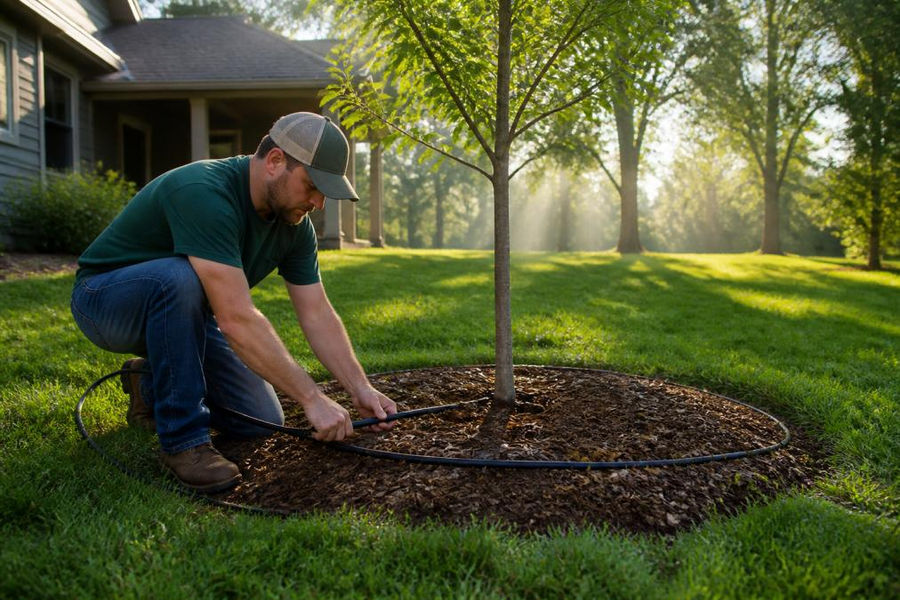
Newly planted trees need water more frequently than established trees because their root systems haven't expanded into surrounding soil. During the first month after planting, water deeply 2-3 times per week, depending on weather and soil conditions. Deep watering, soaking the root ball and surrounding soil thoroughly, is more effective than frequent shallow watering.
Use a soaker hose or drip irrigation positioned at the base of the tree. This delivers water directly to the root zone without wetting the foliage, which reduces disease risk. Water early in the morning when possible to allow soil to absorb moisture before temperature peaks.
Check soil moisture by digging 4-6 inches into the soil near the root ball. If soil feels dry at that depth, it's time to water. If it's still moist, wait another day or two. This simple test prevents both overwatering and underwatering.
Clay soils retain moisture longer than sandy soils, so Iowa trees need less frequent watering than trees in other regions. However, they also drain more slowly, so overwatering is a real risk. The key is finding the balance, moist but not soggy.
During the second growing season, gradually reduce watering frequency as the root system expands. By the third year, most trees should be established enough to rely primarily on natural rainfall. However, during extended dry periods, supplemental watering still helps.
Mulch plays a critical role in moisture retention and temperature moderation. Apply 2-4 inches of mulch in a ring around the tree, starting 3-4 inches from the trunk and extending to the drip line. Mulch reduces soil temperature fluctuations, suppresses weeds that compete for water, and gradually breaks down to improve soil structure. Keep mulch away from the trunk itself to prevent rot and pest problems.
Tree Planting Services West Des Moines and Beyond
While many homeowners successfully plant trees themselves, professional tree planting services offer significant advantages, particularly when dealing with Iowa's challenging clay soils. Anderson Tree Care provides professional planting services that handle every step, from site evaluation and soil preparation through establishment care.
Professional planting ensures proper species selection for your specific site conditions. Our team evaluates drainage, sun exposure, wind patterns, and future space requirements to recommend trees that will thrive for decades. This expertise prevents costly mistakes like planting a shade-loving species in full sun or choosing a tree that outgrows its location.
Soil preparation is where professional services deliver the most value. Rather than guessing at amendment ratios or techniques, professional crews assess your specific soil and apply targeted amendments. They understand how Iowa's clay responds to different treatments and can identify drainage problems that homeowners might miss.
Professional installation also includes proper handling of larger specimens. Trees purchased from nurseries often arrive at sizes that are difficult for homeowners to position safely and correctly. Professional crews have equipment and techniques to handle these specimens without damaging the root system or straining the tree's structural integrity.
Anderson Tree Care's planting services include initial establishment support. We monitor newly planted trees during the critical first season, adjusting watering as weather patterns change and addressing any issues that develop. This hands-on support significantly improves survival rates compared to planting alone.
For homeowners in West Des Moines and surrounding areas, professional planting transforms the process from a weekend project into a comprehensive investment in your property's long-term landscape health. Whether you're planting a single specimen tree or establishing a new landscape, professional guidance ensures success.
Planting Consideration | DIY Approach | Professional Service |
Site evaluation | Basic visual assessment | Comprehensive soil and drainage analysis |
Soil amendment | General compost addition | Tailored amendment based on soil testing |
Species selection | Research and guessing | Expert matching to site conditions |
Installation | Manual labor, risk of errors | Proper technique, equipment, safety |
Establishment monitoring | Homeowner responsibility | Professional oversight and adjustments |
Planting trees successfully in Iowa requires understanding your soil, preparing it properly, and selecting species suited to your site. The heavy clay soils that define Iowa's landscape present challenges, but they're manageable when you approach planting with the right knowledge and techniques. Whether you're tackling this project yourself or working with professionals, the fundamentals remain the same: assess your soil, amend thoughtfully, choose appropriate species, dig correctly, handle roots carefully, and water consistently through the establishment period.
Anderson Tree Care has spent over a decade helping homeowners and property owners in West Des Moines and beyond establish thriving trees despite Iowa's challenging conditions. From initial consultation to long-term maintenance, our team brings expertise that turns planting into a successful, lasting investment in your property's beauty and value. Call or text for an estimate to discuss your planting needs, we're here to help your trees thrive.
Frequently Asked Questions
Q: What is the 10/20/30 rule for tree planting?
A: The 10/20/30 rule helps prevent transplant shock and structural problems. Dig a hole 10 times wider than the root ball but no deeper, backfill with soil amendments mixed with native soil, and water the tree consistently during the first year. This approach reduces root stress and promotes healthy establishment in Iowa's clay soil conditions.
Q: How deep should a tree be planted in the ground?
A: Plant the tree at the same depth it was growing in its container or with its root collar at ground level. The root collar is where the roots meet the trunk. Planting too deep causes girdling roots, root rot, and poor structural integrity. In Iowa's heavy clay soil, shallow planting combined with proper backfill and mulching helps prevent moisture accumulation around the trunk.
Q: What should I mix with soil when planting trees in clay?
A: Amend Iowa's heavy clay soil with organic matter such as compost or aged bark. This improves soil drainage, increases soil aeration, and reduces soil compaction. Avoid adding sand alone, which can create a concrete-like layer. Mix amendments thoroughly with native soil before backfilling to create a transition zone that encourages root growth into surrounding soil.
Q: What is the most common mistake when planting a tree?
A: Planting too deep is a leading cause of tree failure. Many homeowners also backfill with pure compost or amendments, which can cause root circling and girdling roots. In Iowa, failing to account for clay soil drainage and skipping the mulch ring can lead to poor water management. Proper site evaluation, correct planting depth, and appropriate soil amendments help prevent most establishment problems.
Call or Text for estimate


Comments