Residential Tree Trimming: A Complete Guide

Table of Contents
Why Residential Tree Trimming Matters for Your Property
Best Time of Year for Tree Trimming
Signs of Tree Disease in Iowa and When to Act
Tree Trimming Cost Estimates and What Affects Your Price
DIY vs. Professional Tree Trimming: A Risk Assessment Safety Hazards of Chainsaw Work Proper Equipment and Technique Requirements
Safety Hazards of Chainsaw Work
Proper Equipment and Technique Requirements
What Professional Tree Services Include Crown Reduction and Canopy Thinning Deadwood Removal and Hazard Assessment Tree Cabling and Bracing for Structural Support
Crown Reduction and Canopy Thinning
Deadwood Removal and Hazard Assessment
Tree Cabling and Bracing for Structural Support
How to Choose a Licensed and Insured Tree Service
Conclusion
Last Updated: August 28, 2026
Why Residential Tree Trimming Matters for Your Property
Residential tree trimming feels optional until something goes wrong, a branch falls during a storm, trees grow too close to your roof, or diseased limbs drop without warning. Trees on your property are living infrastructure that provide shade, curb appeal, and real value, but they require active management. Untrimmed trees become liabilities: they shed branches unpredictably, create fire hazards, and damage gutters and siding.
Professional residential tree trimming extends tree life, prevents property damage, and protects your family. This guide covers when to trim, how to spot problems, what professionals do, and whether to DIY or hire experts.
Best Time of Year for Tree Trimming
Timing matters significantly. For most deciduous trees (oaks, maples, ash), late winter to early spring, roughly February through March, is optimal (extension.oregonstate.edu). Trees are dormant, wounds heal faster once growth resumes, and you can see the structure clearly without leaves.
Summer trimming is acceptable for light maintenance and hazard removal, but avoid heavy pruning in heat. Fall trimming is risky because trees are moving resources to roots for winter. Spring trimming right after leaf-out can work, but trees are already stressed.
Dead, diseased, or hazardous branches should be removed immediately, regardless of season. A limb hanging over your roof after a storm doesn't wait for February.
Pro Tip Mark your calendar for late winter pruning of major trees. A single professional trimming session every 3-5 years keeps most residential trees healthy and safe.
Signs of Tree Disease in Iowa and When to Act
Iowa's hot, humid summers and freeze-thaw winters stress trees. Local pests and diseases compound the challenge.
Cankers and sunken bark: Dark, sunken areas on trunks or branches indicate cankers, localized dead bark that spreads and can girdle branches, cutting off nutrient flow. Remove affected branches promptly.
Leaf discoloration and early drop: Yellow or brown leaves falling mid-summer signal disease, pest damage, or root stress. Have an arborist assess before the problem spreads.
Oozing or weeping: Excessive sap bleeding from trunks or branches indicates stress or infection.
Visible insects or webbing: Tent caterpillars, spider mites, and webbing in branches mean action is needed. Light infestations can sometimes be managed by removing affected branches.
Mushrooms or fungal growth: Shelf fungi on trunks indicate internal decay and serious structural compromise.
Many diseases can be managed by removing affected branches and improving tree health. Early intervention stops problems from spreading.
Watch Out If a tree is losing major branches to disease or showing advanced decay, get a professional hazard assessment. Delaying this decision puts your property at risk.
Tree Trimming Cost Estimates and What Affects Your Price
Residential tree trimming pricing depends on tree size, condition, location, and scope of work. A 30-foot oak costs more than a 20-foot crabapple. A healthy tree with straightforward structure takes less time than one with disease or complex branching. Trees near structures or power lines cost more due to complexity and safety requirements.
Light pruning to remove dead branches costs less than crown reduction or major removal. Stump grinding is a separate service with its own pricing.
For realistic estimates, get assessments from licensed professionals. Anderson Tree Care provides free estimates that break down needed work, explain why, and specify costs. Avoid quotes that seem unusually cheap, they often mean corners are being cut on safety or quality.
Key Takeaway Tree trimming costs vary widely based on size, condition, location, and scope. Get estimates from licensed professionals. Avoid unusually cheap quotes.
DIY vs. Professional Tree Trimming: A Risk Assessment
Many homeowners see tree trimming as a DIY project to save money, but the cost of mistakes, property damage, injury, or killing the tree, quickly exceeds professional fees.
Safety Hazards of Chainsaw Work
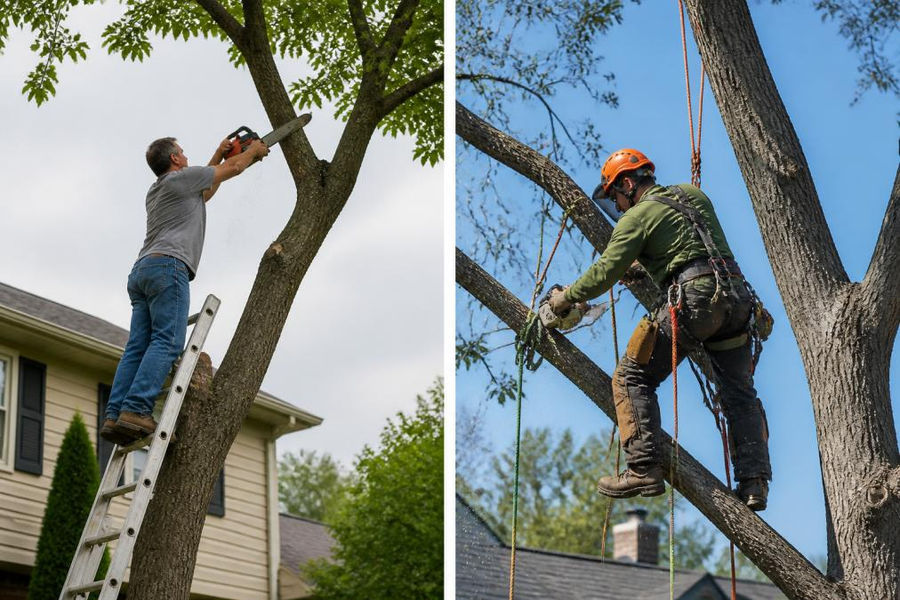
Chainsaws are dangerous tools operating at speeds that don't forgive mistakes. Working at height adds exponential risk. Professionals train extensively on chainsaw safety, understand kickback, and wear protective gear: helmets with face shields, chaps, steel-toed boots, and hearing protection. They use harnesses and ropes when working above ground.
DIY chainsaw work lacks this training and equipment. One slip or miscalculation about where a branch will fall can result in serious injury.
Proper Equipment and Technique Requirements
Improper cuts damage trees. Cutting too close to the trunk removes the branch collar, the tree's natural healing zone, inviting disease (peer-reviewed research). Cutting too far leaves a stub that won't heal well. Cut angles matter, they should slope slightly away from the trunk so water runs off.
Professional arborists understand tree biology and species-specific responses to pruning. They know which branches to remove and which to keep. They use quality, properly maintained equipment and specialized tools like bucket trucks and rigging equipment for larger jobs.
When you add up safety training, proper technique, and appropriate equipment, the cost difference between DIY and professional work shrinks. Professional work is safer, faster, and produces better results for tree health.
What Professional Tree Services Include
Professional tree services are comprehensive, structured approaches to tree health and property protection.
Crown Reduction and Canopy Thinning
Crown reduction reduces the overall size of the tree's canopy when a tree has grown too large for its space or is overhanging structures. Proper crown reduction removes no more than 25% of the canopy in a single season. Cuts are made selectively, removing branches back to a lateral branch or the branch collar.
Canopy thinning removes interior branches to allow light and air penetration, improving tree health by reducing disease risk and improving air circulation. It also reduces wind resistance, helping the tree withstand storms.
Deadwood Removal and Hazard Assessment
Dead branches are removed because they're hazardous and are entry points for disease and pests. Professionals also assess for hidden hazards, branches that appear healthy but have internal rot, pest damage, or structural weakness.
Hazard assessment evaluates whether the tree itself poses a risk to structures, power lines, or people. A professional assessment tells you whether trimming will address the problem or whether removal is better.
Tree Cabling and Bracing for Structural Support
Trees with structural weaknesses benefit from cabling and bracing. Cabling uses steel cables to support weak branches or reduce stress on compromised trunks. Bracing uses rods to support weak unions between branches and trunks. These techniques extend tree life and reduce failure risk.

How to Choose a Licensed and Insured Tree Service
Not all tree services are equal. Some are professional operations with trained staff and proper insurance; others are one-person operations without credentials or coverage.
Licensing and credentials: Ask whether the company is licensed and whether it employs ISA certified arborists. ISA certification means the person has passed a rigorous exam covering tree biology, care practices, safety, and industry standards.
Insurance coverage: Ask to see proof of liability insurance and workers' compensation insurance. A company without proper insurance puts your property and finances at risk.
References and reputation: Ask for references from recent customers and check online reviews. Ask specific questions about timeliness, professionalism, cleanup, and tree health improvement.
Clear communication and estimates: A professional company provides written estimates that break down work, explain why it's needed, and specify costs. They answer questions clearly.
Local knowledge: A company operating in your area for years understands local tree species, pests, diseases, and climate challenges. Anderson Tree Care has over a decade of experience serving the West Des Moines area.
The cheapest quote isn't always the best value. A low price might mean corners are being cut on safety or using untrained workers. Professional companies invest in training, equipment, and safety.
Best For Homeowners seeking professional tree care from an established, experienced company that prioritizes safety and tree health. Anderson Tree Care's decade-plus experience and commitment to industry standards make it the reliable choice for residential tree trimming in this area.
Residential tree trimming is an investment in your property's health and safety. Properly maintained trees live longer, look better, and pose fewer hazards. For most homeowners, professional tree services deliver better results, safer execution, and genuine peace of mind. When you're ready to have your trees assessed and trimmed properly, Anderson Tree Care offers free estimates and has served the area for over a decade. Call or text today to schedule your consultation and protect your property.
Frequently Asked Questions
What is the best time of year for tree trimming in Iowa?
Late winter to early spring (February through March) is ideal for most tree trimming in Iowa. Trees are dormant, making it easier to see branch structure and reducing stress on the tree. Avoid late fall and early winter when trees are preparing for dormancy. Summer trimming is acceptable for removing hazardous branches, but avoid heavy pruning during this season. Spring flowering trees should be trimmed immediately after blooming to preserve next year's flower buds.
How much does residential tree trimming cost?
Tree trimming pricing depends on several factors: tree size and height, number of trees, branch thickness, proximity to structures, and accessibility. Small trees may cost less than large mature oaks or elms. Emergency storm cleanup typically costs more than routine maintenance. For accurate pricing tailored to your property, contact Anderson Tree Care for a free estimate. Our team will assess your specific situation and provide transparent pricing before any work begins.
What are signs that a tree needs professional trimming?
Watch for dead or diseased branches, crossing branches that rub together, branches hanging over your roof or power lines, and excessive growth blocking sunlight to your home. In Iowa, signs of tree disease include cankers, fungal growth, unusual leaf discoloration, pest infestations, and bark damage. If a tree has recently suffered storm damage or shows structural weakness, professional assessment is essential. Trees growing too close to your foundation or siding also benefit from professional crown reduction and canopy thinning.
Why should I hire a professional instead of trimming trees myself?
Professional arborists have training in proper trimming techniques that promote tree health and structural integrity. They carry liability insurance protecting your property if accidents occur. Working at heights with chainsaws involves serious injury risk, falls, cuts, and electrocution hazards exist even for experienced homeowners. Professionals have specialized equipment like bucket trucks and rigging systems. An ISA certified arborist understands tree biology and can prevent damage that weakens or kills your trees, protecting your long-term property value.
Call or Text for estimate


Comments