How to Prevent Tree Storm Damage: A 2026 Guide

Table of Contents
Start With the Right Tree in the Right Spot Choosing Storm-Resistant Species Soil Health and Root Stability
Choosing Storm-Resistant Species
Soil Health and Root Stability
Signs of Hazardous Trees You Should Not Ignore Structural Red Flags to Check Each Season
Structural Red Flags to Check Each Season
How to Prevent Tree Storm Damage Through Routine Pruning Crown Cleaning and Deadwood Removal Managing Codominant Stems and Weak Branch Attachments
Crown Cleaning and Deadwood Removal
Managing Codominant Stems and Weak Branch Attachments
Tree Cabling and Bracing Benefits for Storm Mitigation
Professional Tree Risk Assessment: What It Covers DIY Inspection vs. Hiring a Certified Arborist
DIY Inspection vs. Hiring a Certified Arborist
Regional Storm Prep and Insurance Documentation
How to Prevent Tree Storm Damage: Pre-Season Checklist
Conclusion
Last Updated: August 19, 2026
Most homeowners don't think about their trees until a branch crashes through a roof. At Anderson Tree Care, we've seen that pattern play out dozens of times, and almost every incident was preventable. Learning how to prevent tree storm damage is about building a year-round maintenance habit that keeps your trees structurally sound before severe weather arrives. The core argument is simple: most storm damage isn't caused by the storm itself, but by years of deferred maintenance that the storm finally exposes.
Start With the Right Tree in the Right Spot
Preventing storm damage begins before a tree is ever planted. Species selection and planting location shape every maintenance challenge you'll face for the next 50 years.
Choosing Storm-Resistant Species
Not all trees handle wind, ice loading, and snow equally. Species with dense, flexible wood fare better than those with brittle wood that snaps under stress. Native species are generally safer because they've adapted to local weather patterns over centuries.
For the Midwest, bur oak, Kentucky coffeetree, and American hornbeam offer solid wind resistance. Avoid species known for brittle wood and weak branch attachments, such as silver maple, Bradford pear, and Siberian elm, common culprits in post-storm cleanup calls. According to Iowa State University Extension and Outreach's tree selection resources, matching species to site conditions significantly reduces long-term maintenance demands and storm vulnerability.
Soil Health and Root Stability
A tree is only as stable as its root system. Compacted soil restricts root flare development and forces roots to grow shallow rather than deep. Shallow roots mean poor anchorage during high winds, the tree tips rather than bends.
Soil saturation before storms is particularly concerning. Waterlogged soil loses its grip on root systems, dramatically increasing the risk of whole-tree failure. Aerating compacted soil around the drip line, mulching to retain moisture balance, and avoiding construction damage near root zones are practical steps that pay dividends when severe weather arrives.
Signs of Hazardous Trees You Should Not Ignore
Signs of hazardous trees are often visible well before actual failure. A hazard tree is one with a structural defect, or combination of defects, that makes it likely to fail and cause harm to people or property.
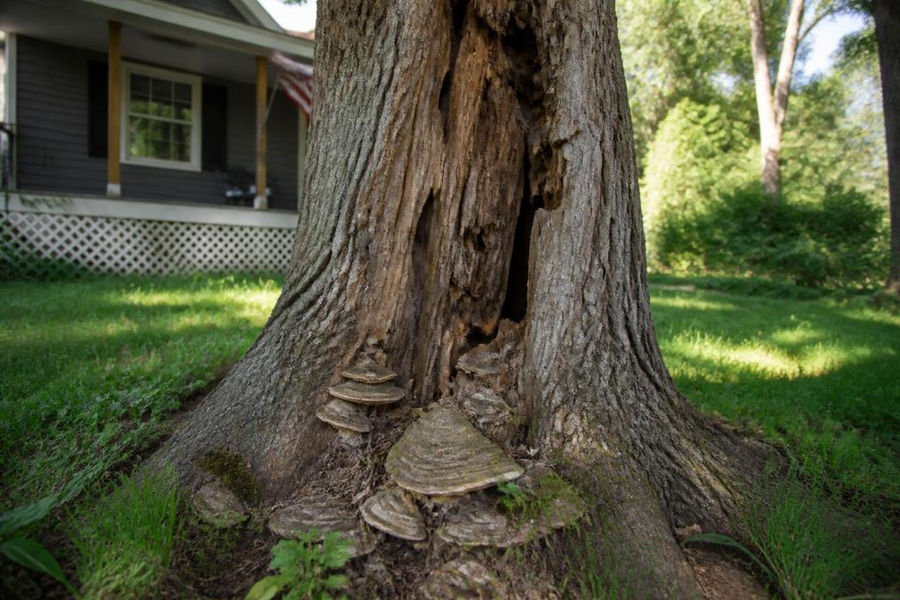
Structural Red Flags to Check Each Season
Walk your property each spring and fall and look for these warning signs:
Codominant stems with a tight V-shaped crotch, creating weak attachment points prone to splitting under ice loading or wind
Deadwood in the upper crown, which becomes a projectile in high winds
Cracks or splits running vertically through the trunk or major limbs
Decay fungi such as shelf mushrooms or conks at the base or along the trunk, indicating internal wood rot
Leaning that has developed or worsened recently, especially combined with soil heaving near the base
Weakly attached limbs with narrow branch angles or girdling bark
Crown dieback concentrated on one side, signaling root damage or vascular disease
One structural red flag alone may not condemn a tree, but two or three together should prompt a professional tree risk assessment before storm season. The International Society of Arboriculture's tree risk assessment resources outlines the framework most certified arborists use to evaluate combined defects.
Watch Out Never ignore decay fungi at the base of a tree. Shelf mushrooms or conks indicate internal decay that may have already compromised structural wood. A tree that looks solid from the outside can be hollow at its core, and failure under these conditions is sudden and gives no warning.
How to Prevent Tree Storm Damage Through Routine Pruning
Routine pruning is the single most effective tool to prevent tree storm damage. A well-pruned tree sheds wind more efficiently, carries less weight in its crown, and has fewer failure points than one left to grow unchecked.
Crown Cleaning and Deadwood Removal
Crown cleaning means removing dead, dying, diseased, or crossing branches from the tree's canopy. This is not topping, which is a damaging practice that should be avoided entirely.
Removing deadwood eliminates the most immediate storm hazard: broken branches held in place only by friction or surrounding branches. In strong wind events, these become dangerous projectiles. Crown thinning, selectively removing live branches to reduce canopy density, improves wind resistance by allowing air to move through the canopy rather than push against it as a solid mass.
Managing Codominant Stems and Weak Branch Attachments
Codominant stems are two or more main stems of roughly equal diameter growing from the same point. Where they meet, bark becomes embedded between the stems rather than forming a solid wood connection. This bark inclusion creates a structural weakness that often fails catastrophically under storm loading.
Management options depend on the tree's age and severity of codominance:
On young trees, early structural pruning can train one stem to become dominant
On mature trees where both stems are large, cabling and bracing systems are often appropriate
In severe cases, removal of one stem or the entire tree may be safest
A certified arborist should make this call.
Pro Tip The best time to address codominant stems on young trees is before they reach 4 inches in diameter. Corrective pruning at that stage is straightforward and inexpensive. Waiting until stems are 12 inches in diameter turns a simple fix into a major structural intervention.
Tree Cabling and Bracing Benefits for Storm Mitigation
Tree cabling and bracing is a structural support system installed to reduce the risk of branch or stem failure in trees with identified weaknesses.

A cabling system typically consists of high-strength steel cables installed in the upper crown to limit movement of codominant stems or heavy limbs. Bracing rods are threaded through weak crotches or cracked stems to hold split sections together. These systems redistribute mechanical stress that wind, ice loading, and snow accumulation place on vulnerable attachment points.
Cabling is most beneficial when the tree has high value, the defect is manageable, removal would cause significant landscape disruption, and the target zone below the tree is occupied frequently. Cabling is not appropriate for trees with advanced internal decay, severe root damage, or multiple compounding defects. According to ANSI A300 standards for tree cabling and bracing, cabling systems should be inspected at least annually and after major storm events.
Cabling systems require professional installation. Improper placement can concentrate stress at the attachment point and accelerate failure rather than prevent it.
Professional Tree Risk Assessment: What It Covers
A professional tree risk assessment is a systematic evaluation of a tree's likelihood of failure and the consequences if it does fail. A qualified arborist will evaluate the tree's species, structural form, defect type and severity, root zone condition, and the target zone below the tree. The output is a risk rating, typically low, moderate, high, or extreme, along with specific mitigation recommendations.
DIY Inspection vs. Hiring a Certified Arborist
Homeowners can and should do basic visual inspections. Walking your property twice a year and knowing the structural red flags puts you ahead of most people. But there's a clear threshold where DIY inspection ends and professional assessment begins.
Situation | DIY Inspection | Hire a Certified Arborist |
Annual visual walkthrough | Appropriate | Optional |
Tree near a structure or power line | Supplement only | Required |
Visible decay, cracks, or lean | Document and monitor | Required |
After a major storm event | First look | Recommended |
Codominant stems on mature tree | Identify | Required for management |
Tree with multiple combined defects | Flag concern | Required |
Pre-sale property inspection | Useful | Recommended |
A certified arborist carries credentials from the International Society of Arboriculture and carries insurance. Their assessment is defensible, and if something goes wrong during work on your property, you're protected.
Key Takeaway Hiring a certified arborist is about expertise and accountability. A fully insured and licensed tree care professional takes responsibility for the work performed on your property. That protection is worth more than the cost difference between a credentialed professional and an uncredentialed one.
Regional Storm Prep and Insurance Documentation
Storm preparation isn't generic. Midwest properties face straight-line wind events, ice storms that add tremendous weight to branches, and spring derechos that arrive fast and hit hard. Ice loading is particularly destructive because it affects trees that look perfectly healthy. A half-inch of ice on a large canopy tree can add hundreds of pounds of weight to branches never designed to carry that load. Crown thinning before ice storm season reduces the surface area available for ice accumulation, directly reducing branch failure rates.
Insurance documentation matters when a tree on your property falls and damages a structure. Keep records of pruning dates and scope, any arborist reports or risk assessments, photographs of tree condition before and after maintenance, and invoices from licensed tree care professionals. If a neighbor's tree falls onto your property, liability depends on whether the tree owner had been notified of a hazard condition. The Insurance Information Institute's guidance on trees and homeowner insurance explains how most policies handle tree damage claims.
How to Prevent Tree Storm Damage: Pre-Season Checklist
Use this checklist each spring and fall to systematically prevent tree storm damage before severe weather season arrives.
Spring Checklist (before storm season):
Walk the entire property and photograph all mature trees
Check for new deadwood that developed over winter
Inspect codominant stems for worsening bark inclusion
Look for new decay fungi, cracks, or lean changes
Schedule pruning for any trees with crown cleaning needs
Verify that existing cabling systems are intact after winter
Clear any branches within 10 feet of the roofline
Check soil saturation drainage patterns around large trees
Book a professional tree risk assessment for any flagged trees
Fall Checklist (before ice storm season):
Perform crown thinning on dense-canopied trees before ice season
Remove any deadwood identified during the growing season
Document all maintenance work with dates and photos
Confirm arborist insurance certificates are current
Review homeowner's insurance policy for tree damage coverage
Address any soil compaction issues before ground freezes
Flag any trees that need removal before spring for scheduling
Treat this checklist as a non-negotiable seasonal task, not a reaction to storm warnings. By the time a storm watch is issued, the window for meaningful preparation has closed. Preventative maintenance done in calm weather is what actually reduces risk.
Storm damage to trees is largely preventable. Homeowners who avoid it aren't lucky, they're proactive. If you have mature trees near your home, codominant stems you've been watching, or a tree that just doesn't look right, don't wait for the next weather event to force the issue. Anderson Tree Care brings over a decade of experience, full licensing, and insurance to every job, from routine pruning and deadwood removal to professional tree risk assessments and cabling installation. Call or text for an estimate and get ahead of storm season before it arrives.
Frequently Asked Questions
Which types of trees are most vulnerable to storm damage?
Trees with brittle wood, shallow root systems, or poor branch structure tend to fail first in storms. Species like silver maple, Bradford pear, and Siberian elm are commonly cited for weak branch attachments and brittle wood. Codominant stems, two trunks of equal size competing from the same base, are especially prone to splitting under ice loading or high winds. Selecting structurally sound, regionally appropriate species at planting time is one of the most effective long-term strategies to prevent tree storm damage.
How often should trees be inspected for storm risks?
Most arborists recommend a professional tree risk assessment at least once a year, ideally in late winter or early spring before new growth begins. Mature trees near structures, trees that have experienced recent drought or flooding, and any tree showing signs of hazardous trees, such as dead branches, leaning trunks, or decay fungi, warrant more frequent checks. After any major storm, a post-event walkthrough helps catch new structural damage before it becomes a hazard.
Will homeowners insurance cover storm damage to trees?
Coverage varies by policy. Most standard homeowners insurance covers tree removal when a fallen tree damages an insured structure like your home or fence, but rarely covers removal of a tree that fell in the yard without hitting anything. Documenting your trees with dated photos and keeping records of professional pruning and risk assessments strengthens any claim and demonstrates preventative maintenance. Contact your insurance provider directly to confirm the specific terms of your policy before a storm occurs.
Can professional pruning actually prevent tree failure during storms?
Yes. Crown thinning improves wind resistance by reducing the sail effect of a dense canopy. Removing deadwood, weakly attached limbs, and crossing branches lowers the load the tree carries during high winds, ice loading, or snow accumulation. A certified arborist follows ANSI A300 pruning standards to remove the right material without compromising the tree's structural integrity. Routine pruning is one of the most cost-effective forms of preventative maintenance for storm mitigation.
Call or Text for estimate


Comments