How to Choose a Certified Arborist: 2026 Guide

Table of Contents
What Makes a Certified Arborist Different From a Tree Trimmer
How to Verify Professional Credentials and ISA Certification Using the ISA Online Directory to Confirm Certification Licensing, Insurance, and Bonding Requirements
Using the ISA Online Directory to Confirm Certification
Licensing, Insurance, and Bonding Requirements
Red Flags to Watch for Before You Hire Anyone Visual Red Flags on the Job Site Contractual Red Flags in Estimates and Agreements
Visual Red Flags on the Job Site
Contractual Red Flags in Estimates and Agreements
Questions to Ask a Tree Service Company Before Signing Anything
Understanding Tree Removal Cost Estimates
Post-Storm Urgency vs. Due Diligence: Don't Skip Verification
Specialized Equipment and ANSI Safety Standards
Conclusion
Last Updated: August 18, 2026
What Makes a Certified Arborist Different From a Tree Trimmer
Most people assume anyone with a chainsaw and a truck can handle tree work. That assumption costs homeowners thousands of dollars in property damage every year, and in the worst cases, it costs them much more.
A certified arborist is a tree care professional who has passed a rigorous examination administered by the International Society of Arboriculture (ISA), demonstrating verified knowledge of arboriculture, tree biology, soil science, pruning standards, and hazard assessment. A tree trimmer, by contrast, may have zero formal training and no accountability structure whatsoever.
The practical difference is enormous. A certified arborist can perform a tree risk assessment, identify disease or structural failure before it becomes a crisis, and recommend the right intervention, whether that's pruning, cabling, or removal. An untrained worker is guessing. For mature trees near your home, guessing is not acceptable.
This guide breaks down exactly how to evaluate, verify, and hire the right professional for your trees, so you never have to wonder whether the person in your yard actually knows what they're doing.
How to Verify Professional Credentials and ISA Certification
Verifying a certified arborist's credentials takes about five minutes and protects you from a category of contractor fraud that is more common than most homeowners realize.

The ISA credential is the gold standard in the arboriculture industry. When a contractor claims to be ISA-certified, that certification should be verifiable in real time. According to the International Society of Arboriculture credential verification page, certification holders must complete continuing education requirements to maintain their status, which means an active certification signals ongoing professional development, not just a one-time test.
Using the ISA Online Directory to Confirm Certification
The ISA maintains a public directory where you can search any arborist by name or zip code and confirm their certification status, specialty credentials, and whether the certification is currently active. Always do this before signing anything.
Here is the verification process:
Visit the ISA's official Find an Arborist tool
Enter the contractor's name and your zip code
Confirm the certification number matches what they provided
Check the expiration date and specialty designations (such as Utility Specialist or Municipal Specialist)
If a contractor claims certification but does not appear in the directory, treat that as a disqualifying red flag.
Licensing, Insurance, and Bonding Requirements
Credentials alone are not enough. Any legitimate tree service company must carry two specific types of insurance: general liability and workers' compensation. These are not interchangeable, and both matter.
General liability insurance covers damage to your property. Workers' compensation covers injuries to workers on your property. Without workers' comp, you can be held liable if a crew member is injured while working on your land. Many states require both, and you should request certificates of insurance directly from the insurer, not a photocopy from the contractor.
Ask whether the company is also bonded. A surety bond provides additional protection if the contractor fails to complete agreed work or causes financial harm. Licensing requirements vary by state, so check with your state's licensing board to confirm what is required in your area.
Pro Tip Call the insurance company directly using the number on the certificate to verify the policy is active. Fraudulent certificates are not uncommon in the trades, and a 60-second phone call eliminates the risk entirely.
Red Flags to Watch for Before You Hire Anyone
The biggest mistake homeowners make is treating urgency as a reason to skip verification. It is not. A tree hanging over your roof is stressful, but a bad contractor can make that situation dramatically worse.
Visual Red Flags on the Job Site
Before work begins, pay attention to what you see. Professional tree crews show up with appropriate equipment for the scope of work. If someone shows up to remove a 60-foot oak with nothing but a pickup truck and a chainsaw, that is not a professional operation.
Red flag visual checklist:
No bucket truck or climbing gear for large canopy work
Workers without helmets, eye protection, or chainsaw chaps
No chipper or plan for debris removal
Vehicle has no company name, phone number, or signage
Crew appears to have no designated ground person during climbing
Professional arborists follow ANSI Z133 safety standards, which govern safe work practices for arboricultural operations. A crew that ignores basic personal protective equipment is almost certainly not following those standards anywhere else either.
Contractual Red Flags in Estimates and Agreements
A written estimate is not optional. Any contractor who resists putting the scope of work in writing is giving you a warning you should not ignore.
Watch for these contractual red flags:
Vague scope language: "Remove tree" with no specification of stump, debris, or cleanup
No mention of insurance: A legitimate contractor includes proof of coverage without being asked
Unusually low bids: Dramatically underbidding competitors often signals unlicensed, uninsured work
Demand for full payment upfront: A reasonable deposit is normal; full payment before work starts is not
No company address or license number: Legitimate businesses have a verifiable physical presence
High-pressure tactics: Any contractor pushing you to sign immediately is not giving you time to verify them
Watch Out Verbal agreements are nearly worthless when something goes wrong. If a contractor damages your fence, your foundation, or a neighboring property and there is no written contract specifying liability, your legal options become significantly more complicated and expensive.
Questions to Ask a Tree Service Company Before Signing Anything
Knowing what questions to ask a tree service company separates homeowners who get professional results from those who get expensive regrets. These questions also signal to legitimate contractors that you are an informed client, which tends to bring out better performance.
Ask every candidate these questions before you commit:
Can you provide your ISA certification number so I can verify it? A legitimate arborist will give this without hesitation.
Can I receive certificates of insurance directly from your insurer? This is the only way to confirm coverage is real and current.
Who specifically will be on my job, and are they trained and supervised? Subcontracting without disclosure is common and worth asking about directly.
What does site cleanup include? Confirm whether stump grinding, chip removal, and debris hauling are included or priced separately.
Have you done similar work in this area, and can I contact references? Past work near homes with similar tree species and site conditions is directly relevant.
What happens if something goes wrong? Their answer to this question tells you more about their professionalism than almost anything else.
One more question that most guides skip: ask whether they carry a consulting arborist on staff or have access to one. For complex hazard assessments or diseased trees, a consulting arborist provides a level of diagnostic depth that a crew foreman cannot.
Question | What a Good Answer Sounds Like |
ISA certification verification | Provides number immediately, no hesitation |
Insurance certificates | Offers to have insurer send directly |
Who is on the crew | Names supervisor, confirms training |
Site cleanup scope | Itemizes stump, chips, debris explicitly |
References | Provides 2-3 with contact details |
If something goes wrong | Explains liability process clearly |
Understanding Tree Removal Cost Estimates
Tree removal cost estimates vary based on factors that are genuinely difficult to standardize: tree height, trunk diameter, proximity to structures, site access, species, and whether stump grinding is included. Anyone who gives you a firm price without seeing the tree in person is either guessing or setting you up for a change order.
The benefits of hiring a certified arborist for an in-person estimate go beyond price. A qualified professional will assess the tree's structural condition, root system, and proximity to utilities before quoting, which means the estimate reflects actual risk and actual scope. An uncredentialed contractor may underbid because they have not identified complications they will discover mid-job.
Get a minimum of three written estimates for any significant tree work. Compare them line by line, not just by total price. A lower total that excludes stump grinding, debris removal, or site cleanup may end up costing more than a higher bid that includes everything.
Anderson Tree Care provides written estimates after an in-person assessment, so the price you receive reflects the actual conditions of your property. Call or text to schedule yours.
Key Takeaway The lowest bid is rarely the best value in tree work. What matters is whether the scope is complete, the contractor is verifiable, and the insurance is real.
Post-Storm Urgency vs. Due Diligence: Don't Skip Verification
A severe storm creates a specific vulnerability for homeowners: urgency. A branch through your roof or a tree leaning toward your house demands attention, and that pressure is exactly what certain contractors exploit.
Storm chasers, as the industry calls them, are unlicensed operators who appear in neighborhoods immediately after severe weather events, offering fast service at prices that seem reasonable under the circumstances. They collect payment, do partial work or no work, and disappear. This is not a rare occurrence. According to the Federal Trade Commission's guidance on post-disaster contractor fraud, this pattern spikes after every major weather event.
The verification steps do not change because the situation feels urgent. If anything, they matter more. A contractor working on a storm-damaged tree is dealing with unpredictable load distribution, compromised root systems, and elevated fall risk. That is exactly when you need someone with real training and real insurance.
Emergency tree care from a legitimate provider can often be scheduled within 24 to 48 hours. If a contractor is pressuring you to skip the paperwork because they can "start right now," that pressure is the red flag.
Watch Out Never pay in full for emergency tree work before it is completed. A reasonable emergency deposit is standard; full upfront payment is not. Contractors who disappear after collecting payment are disproportionately concentrated in post-storm scenarios.
Specialized Equipment and ANSI Safety Standards
Professional tree care requires specialized equipment that represents a significant investment, and that investment is part of what you are paying for when you hire a qualified crew.
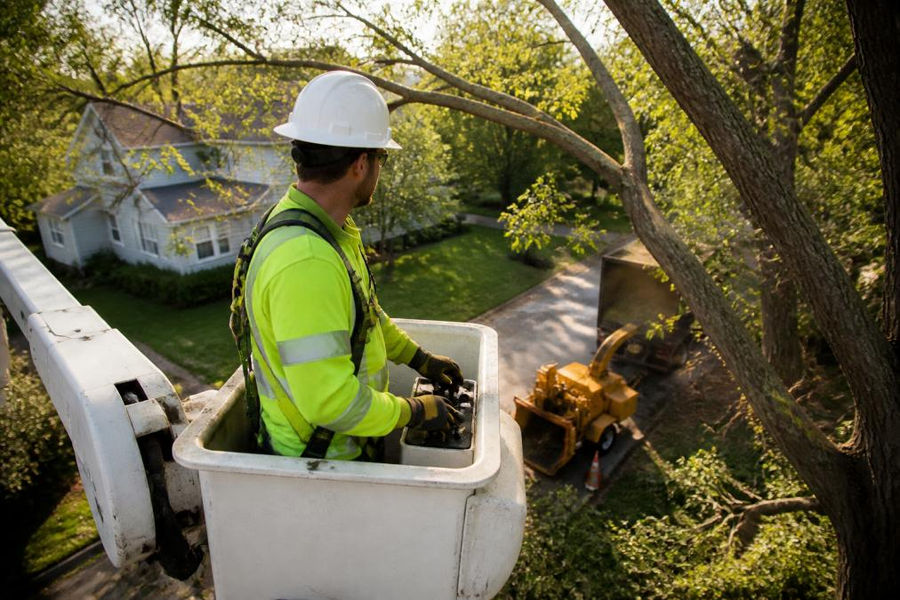
Standard equipment for professional tree removal and pruning includes bucket trucks for elevated access, wood chippers for debris processing, stump grinders, and specialized climbing gear including ropes, saddles, and carabiners rated for arboricultural use. A crew without these tools is either taking shortcuts or subcontracting the work to someone else, which creates accountability gaps.
The governing safety standard for arboricultural work is ANSI Z133, which covers everything from climbing equipment inspection to chipper operation to ground crew positioning. According to ANSI Z133 safety standards for arboricultural operations, compliance with these standards is the professional baseline, not an optional enhancement. ISA-certified arborists are trained on these standards as part of their certification curriculum.
What this means practically: ask whether the company's equipment is regularly inspected and whether their crew is trained on ANSI Z133. A professional will know exactly what you are asking. An untrained operator may not recognize the acronym.
The benefits of hiring a certified arborist extend directly from this equipment competency. Proper climbing gear prevents falls. A well-maintained chipper reduces debris handling time and injury risk. A bucket truck allows precise canopy work that ground-based cutting cannot achieve. These are not luxury items; they are the tools that make professional tree removal safe.
For large trees near structures, bucket truck access may determine whether removal is even feasible without risk to your home. A contractor who lacks that equipment and does not disclose it is not equipped to do the job safely.
Tree work is one of the few home services where hiring the wrong person can result in structural damage, serious injury, or both. The verification steps in this guide take less than an hour and eliminate the vast majority of risk. Anderson Tree Care is fully insured, licensed, and has more than a decade of experience serving residential properties in the West Des Moines area. Our team handles tree trimming, removal, stump grinding, and planting with the kind of care that comes from treating every property like it belongs to someone we know. For questions about your trees or to schedule an in-person estimate, call or text Anderson Tree Care directly.
Frequently Asked Questions
What's the difference between a tree trimmer and a certified arborist?
A tree trimmer typically performs basic cutting work without formal training in tree biology or risk assessment. A certified arborist has passed an ISA exam covering arboriculture, tree health, pruning standards, and hazard assessment. That training matters when a tree is diseased, structurally compromised, or close to a structure. For routine aesthetic trimming, the difference may seem minor. For anything involving a mature tree near your home, the expertise of a certified arborist can prevent serious property damage or injury.
How can I verify an arborist's ISA certification?
The International Society of Arboriculture maintains a public directory at trees.isa-arbor.com where you can search by name, certification number, or zip code. Every ISA-certified arborist has a unique credential number and a listed expiration date, since certification must be renewed through continuing education. Always ask the arborist for their certification number before hiring, then confirm it matches the directory listing. A legitimate professional will have no hesitation providing this information upfront.
Do arborists need to be insured and bonded?
Yes. Any professional tree service company should carry both general liability insurance and workers' compensation coverage. Liability insurance protects your property if something goes wrong during the job. Workers' compensation covers the crew if someone is injured on your property, without it, you could be held financially responsible. Always request certificates of insurance directly from the provider, not just a verbal confirmation, and verify the policy is current before work begins.
What questions should I ask before hiring a tree service?
Ask for their ISA certification number and verify it online. Request proof of liability insurance and workers' compensation. Ask whether they follow ANSI A300 pruning standards. Find out what equipment they plan to use and how they handle site cleanup. Request a written estimate that itemizes all work, including stump grinding if applicable. Ask for references from recent jobs similar to yours. A qualified professional will answer all of these without hesitation.
How much does professional tree care typically cost?
Tree care costs vary widely based on tree size, species, location relative to structures, and the scope of work, whether it's pruning, full removal, or stump grinding. Because no two jobs are identical, specific price ranges are difficult to give without an on-site assessment. Avoid any company that quotes a flat price without seeing the tree first. The best approach is to request written estimates from two or three ISA-certified providers so you can compare scope, not just price.
Why is it important to hire an ISA-certified professional?
ISA certification means the arborist has demonstrated knowledge of tree biology, proper pruning techniques, hazard assessment, and industry safety standards. This matters because improper cuts can permanently damage or kill a tree, and incorrect removal near structures can cause serious property damage. Certified arborists also stay current through continuing education, so their methods align with current ANSI standards. For any tree work involving mature trees, hazard assessment, or proximity to your home, that credential is a meaningful indicator of competence.
Call or Text for estimate


Comments